



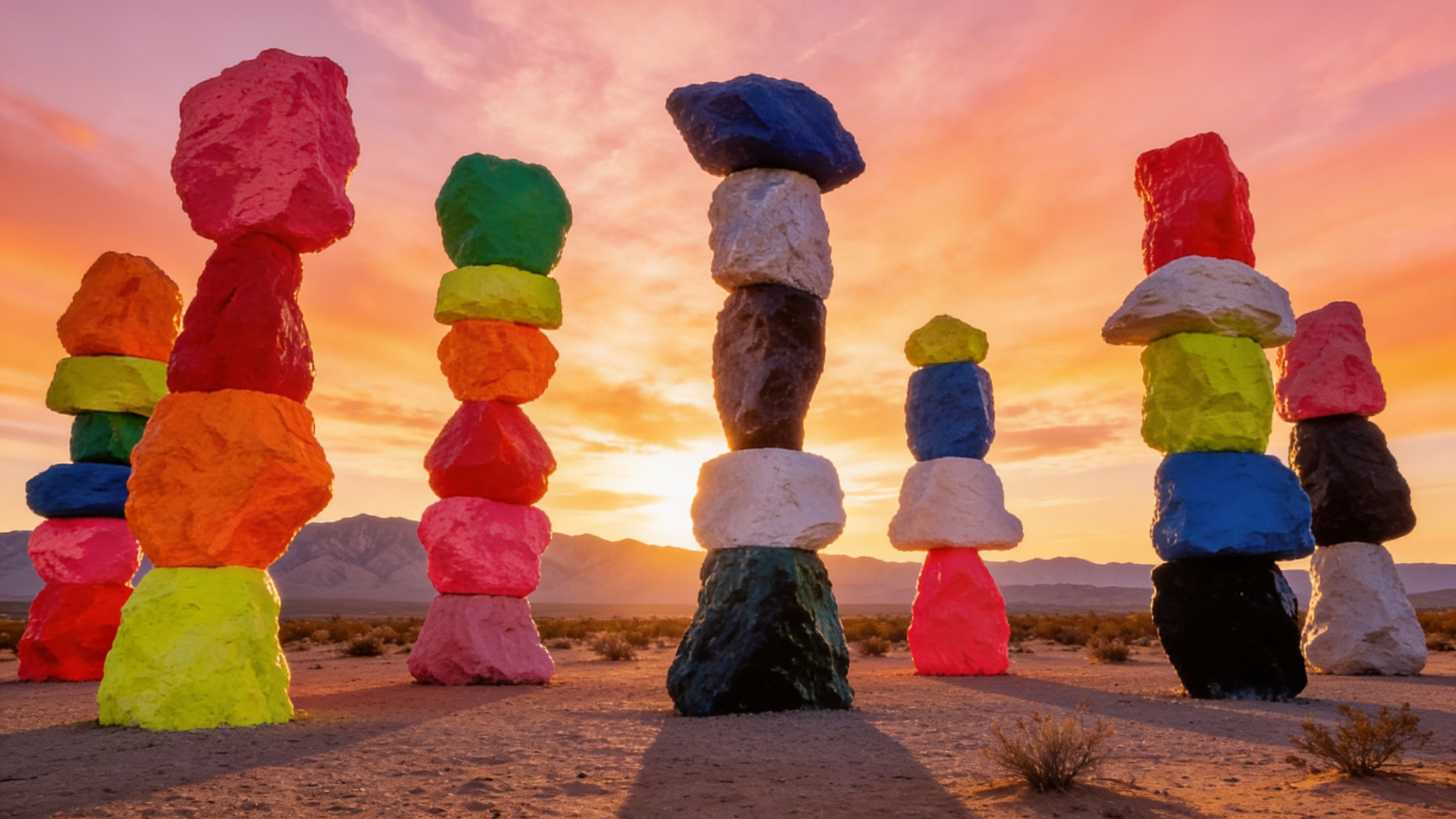
Seven towers of neon-painted boulders standing 30 to 35 feet tall in the Mojave Desert, 10 miles south of Henderson, free to visit, open every day, and freshly repainted in April 2026. One of the most photographed public art installations in the American West is right here, and it is worth making the drive.
What It Is and Why It Exists
Seven Magic Mountains is a large-scale public artwork by Swiss artist Ugo Rondinone, produced by the Nevada Museum of Art and the Art Production Fund in New York. It consists of seven towers of locally sourced boulders, 33 rocks in total, each weighing between 10 and 25 tons, stacked in groups of three to six and painted in vivid Day-Glo colors that are activated by sunlight. The towers stand between 30 and 35 feet tall and are held together by an internal steel backbone anchored into the desert floor. They sit on Bureau of Land Management land near Jean Dry Lake off Interstate 15, approximately 10 miles south of Henderson and about 25 minutes from the Las Vegas Strip.
The installation opened in May 2016, originally scheduled to remain on view for two years. It has been extended repeatedly because of its popularity and cultural significance, drawing approximately 325,000 visitors per year from around the world. The project cost $3.5 million and was sponsored by Aria Resort and Casino and International Game Technology. It is free to visit. No ticket, no reservation, no fee of any kind.
The concept behind the work is rooted in the landscape around it. Rondinone was inspired by the hoodoos, natural spire formations found across the American West, and by the neon energy of Las Vegas itself, creating a bridge between the organic and the artificial, the ancient and the modern. Standing among them in the desert, with the Spring Mountains to the west and nothing but open sky above, the scale of the installation makes an impression that photographs never fully capture.
Freshly Repainted and Looking Vivid Right Now
Six of the seven towers were repainted in April 2026 by a maintenance crew working under the oversight of Rondinone’s studio and a local contractor. The work began April 6 and wrapped by April 24. The towers are painted with environmentally-friendly Day-Glo pigments, not automotive paint, which fade gradually under the desert sun and require periodic restoration to maintain their full vibrancy. This is the third repainting since the installation opened in 2016. The result is that Seven Magic Mountains is currently showing the freshest and most saturated version of its colors since the last restoration. If you have been before and thought the colors looked faded, now is the time to go back.
The Lease Expires in December 2026
The Bureau of Land Management lease that permits Seven Magic Mountains to occupy its current location expires in December 2026. In 2024, Washoe County commissioners voted to allocate $500,000 to potentially relocate the installation to Northern Nevada, but artist Ugo Rondinone and the Nevada Museum of Art decided against the move. The installation will not be leaving Las Vegas. What happens after December 2026, whether the lease is extended, the installation moves to another Clark County site, or it transitions to a new form, is still being determined in communication between the Nevada Museum of Art and Rondinone’s studio. The museum has described whatever comes next as “the next iteration of the piece.” Nothing has been announced and the installation remains fully open through the remainder of 2026. Visit before the end of the year to guarantee you see it in its current location.
How to Get There and What to Expect
Seven Magic Mountains is located at South Las Vegas Boulevard near Jean Dry Lake, off Interstate 15 approximately 10 miles south of Henderson. From the Strip, the drive runs 25 to 30 minutes depending on your starting point. Take I-15 South toward Jean and watch for the installations on the right side of the highway, they are visible from the freeway and impossible to miss. The free parking lot is directly off Las Vegas Boulevard South with a designated pedestrian path to the installation. No other facilities are available on site, no restrooms, no food, no shade structures. The path from the parking lot to the towers is unpaved desert terrain. Wear appropriate footwear and bring water.
The site is open every day from sunrise to sunset with no closing time enforced. There is no charge to park or visit. The experience runs 20 to 45 minutes for most visitors depending on how much time you spend photographing the towers from different angles and distances. The installation looks different from every direction and at every time of day. The most dramatic light is either early morning when the desert is still cool and the colors catch the low eastern sun, or late afternoon when the sky shifts toward gold and the mountains provide a dark backdrop behind the towers.
When to Go and What to Bring
The best time to visit is October through April when desert temperatures are comfortable for walking and standing outdoors. From May through September, the Mojave Desert heat makes a midday visit genuinely unpleasant and potentially dangerous. If you visit in summer, go at sunrise or within the first hour of daylight and be back in your car before 9am. The desert floor around the installation offers zero shade. Temperatures regularly exceed 110 degrees Fahrenheit at ground level in July and August.
For photography, the three best windows are sunrise, late afternoon, and sunset. Sunrise delivers soft directional light from the east with the mountains still in shadow behind the towers. Late afternoon brings warm golden tones across the boulders with the sky beginning to shift. Sunset is the most dramatic option of all, the Day-Glo colors intensify as the light drops, the sky behind the Spring Mountains turns deep orange and purple, and the towers hold their vibrancy well into dusk. Many photographers rank sunset at Seven Magic Mountains as one of the best shots available anywhere in the Las Vegas area. Plan to arrive 45 minutes before sunset to set up and stay through the last light.
Bring sunscreen regardless of season, the desert sun at this latitude is intense even in winter. Bring water even for a short visit. Watch for rattlesnakes on and near the path from the parking area to the installation, particularly in spring and fall when snakes are most active. Signs at the site remind visitors to stay on the designated path. The site is fully accessible, the path from the parking lot to the viewing area is wide and flat enough for most mobility needs, though the surface is unpaved.
The Full IYKYK Breakdown
| Topic | What You Need to Know |
|---|---|
| Location | South Las Vegas Boulevard near Jean Dry Lake, off I-15 South. Approximately 10 miles south of Henderson, 25 to 30 minutes from the Strip. |
| Cost | Completely free. No ticket, no reservation, no parking fee. |
| Hours | Open every day from sunrise to sunset. No enforced closing time. |
| Fresh Paint | Six of seven towers were repainted in April 2026. Currently showing the most vibrant colors since the last restoration. Best time to see it since 2021. |
| Lease Status | BLM lease expires December 2026. Installation will not move to Washoe County. Nevada Museum of Art and the artist are in discussions about the next iteration. Visit before year-end to guarantee seeing it in its current location. |
| Best Time to Visit | October through April for comfortable temperatures. Early morning or late afternoon for the best photography light. Sunrise visits in summer are the only safe option from June through September. |
| What to Bring | Water, sunscreen, and closed-toe footwear. No shade on site. No restrooms. No food or facilities of any kind. |
| Duration | 20 to 45 minutes for most visitors. The towers look different from every angle and in different light, walk the full perimeter for the best experience. |
| Wildlife | Rattlesnakes are present in the area, most active in spring and fall. Stay on the designated path and watch your step. |
| Artist | Swiss artist Ugo Rondinone. Produced by the Nevada Museum of Art and Art Production Fund. Opened May 2016. Cost $3.5 million. Draws approximately 325,000 visitors per year. |
| More Info | sevenmagicmountains.com |
